
 EN
EN
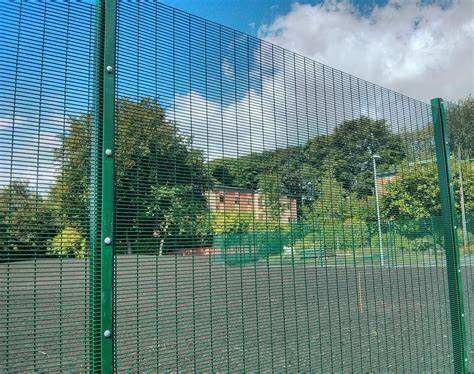
What Is a 358 Fence? Decoding the Standard and Its Security Advantages
Known as 358 fence, prison mesh, or sometimes anti-climb fencing, this security barrier gets its name from specific dimensions. The design features openings that measure about 3 inches wide and half an inch tall, made from 8 gauge high tensile steel wire roughly 4mm thick. What makes this setup stand out is how it meets and actually goes beyond the ASTM F1487 standards for secure perimeters. The pattern removes any places where someone could get a foot hold or grab onto the fence, which means there are no weak spots throughout the whole panel structure. Security professionals often point to these characteristics when recommending this type of fencing for maximum protection against unauthorized access.
The Meaning of '358': Mesh Dimensions, Wire Gauge, and ASTM F1487 Compliance
The number 358 isn't just random sizing but represents specific engineering standards developed for particular applications. When looking at the specs, we find apertures measuring less than 76 mm (about 3 inches by half an inch) combined with wire thicknesses reaching up to 4 mm. This combination effectively blocks any possible leverage points needed for someone trying to climb or cut through the material. At each intersection point, the wires are completely welded together instead of being twisted or crimped. This welding method spreads out forces evenly across the entire panel surface, preventing stress buildup at potential weak spots where failures might occur. To combat corrosion issues, manufacturers apply either ISO 1461 certified hot dip galvanization or alternative Galfan coatings made from zinc aluminum alloys. These protective layers have been tested extensively using third party salt spray methods, showing they can last well over 25 years even when exposed to harsh environmental conditions.
Why 358 Fence Outperforms Conventional Welded Wire in Forced Entry Resistance
Standard welded wire fences typically feature larger apertures (e.g., 2" Ã 2" or 3" Ã 3") and thinner wires (10â12 gauge), making them vulnerable to sustained manual attack. In contrast, 358 fencing delivers measurable performance advantages:
- Resists bolt cutter penetration for over 5 minutes (Ponemon Institute, 2023), enabling critical response time
- Blocks climbing through sub-76 mm apertures that prevent toe and finger purchase
- Maintains optical clarity for CCTV coverage while resisting tampering due to its solid-panel visual effect
This combination makes it the preferred choice for utilities, transport hubs, data centers, and other critical infrastructure where visibility, durability, and delay time are non-negotiable.
Critical 358 Fence Selection Criteria for Maximum Perimeter Integrity
Material & Coating: Galvanized Steel vs. Galfan, ISO 1461 Adherence, and Lifespan Impact
Material selection directly determines long-term performance. ISO 1461-compliant hot-dip galvanizing provides 20â30 years of corrosion protection in inland or moderately aggressive settings. For coastal, industrial, or high-humidity locations, Galfan coatings extend service life by up to 40% due to superior adhesion and sacrificial protection. Key validation criteria include:
- ASTM A641 compliance for minimum tensile strength (â¥550 MPa)
- Minimum coating thickness of 70 μm (verified per ISO 1461)
- Third-party certification confirming 1,000+ hours of neutral salt-spray resistance
Substandard coatings accelerate localized rust formation, compromising weld integrity and reducing forced-entry resistanceâeven if initial mesh strength appears adequate.
Structural Integration: Post Spacing, Tensioning Systems, and Anti-Climb Design Best Practices
A high-specification mesh only performs as intended when correctly installed. To preserve rigidity and anti-climb function:
- Max post spacing: 2.4 m (8 ft) for 8-gauge systems; tighter spacing (â¤2 m) recommended for taller installations (>3 m)
- Hydraulic tensioning systems reduce installation-induced microfractures by 65% versus manual methods, preserving fatigue resistance
- Top design must incorporate either a 45°â60° angled cap or integrated deterrents (e.g., blade barriers) to eliminate handholds
- Foundations require minimum 915 mm (36") depth in undisturbed soil, with reinforced concrete footings to resist prying and leverage attacks
When implemented per CPNI SR4 guidelinesâincluding proper anchoring, tensioning, and top treatmentâthis configuration achieves verified delay times exceeding 4 minutes against professional intrusion tools.
Application-Specific Optimization of Your 358 Fence System
Height, Top Guard Options, and Compatibility with CCTV or Electric Detection Sensors
Optimizing 358 fencing requires aligning physical specifications with site risk profiles. For high-value assets like power substations or airports, a minimum height of 2.4 m is advised; 3.0 m or greater is recommended where terrain or adjacent structures enable elevated access. Top-mounted enhancements significantly increase deterrence:
- Angled blade or razor wire barriers reduce successful climb attempts by 83% in controlled trials
- Low-energy electric detection systems (1â5 kV) cut intrusion attempts by 96%, triggering alarms before contact is made
- Embedded fiber-optic vibration sensors detect climbing motion within 0.8 seconds, enabling real-time alerting
Crucially, 358âs open-weave design supports seamless integration with AI-powered thermal CCTVâdelivering 99.1% accuracy in distinguishing human threats from environmental false positives (Perimeter Security Journal, 2023). Unlike solid walls or opaque barriers, it enables layered security without sacrificing surveillance fidelity.
| Enhancement Type | Effectiveness |
|---|---|
| Razor/Blade Barriers | 83% breach reduction |
| Electric Systems (1â5 kV) | 96% intrusion deterrence |
| AI Thermal CCTV | 99.1% threat identification accuracy |
This synergy ensures perimeter resilience scales with threat sophisticationâwithout requiring structural compromise.
Validating Performance: Real-World 358 Fence Effectiveness and Lessons Learned
In actual installations, 358 fencing has proven itself as one of the top performers when it comes to securing perimeters. Facilities that switched from standard chain-link to 358 saw around 74% fewer cases where people tried to climb over illegally. This makes sense since the 3 inch by half inch holes in the pattern just don't give anyone anywhere to put their feet. Lab tests certified by UKAS showed that even when attackers used heavy tools like hydraulic spreaders and bolt cutters, they failed about 95% of the time against 358 panels. The secret? Its super strong steel rated at 550 MPa combined with a welded design that spreads out force across the whole panel instead of letting it concentrate in one spot. According to research done by Ponemon Institute in 2023, most attempts to break through took about 26 minutes before succeeding, which is way beyond what ASTM standards require for Level III security (just 5 minutes). That kind of difference matters a lot in real-world situations.
The findings point to something pretty clear about system 358: its performance isn't just about the mesh material itself. Real effectiveness comes when this mesh works hand in hand with proper installation methods like those specified in ISO 1461 coatings standards, correct tensioning according to CPNI guidelines, and adequate foundation depths. Without these elements, the whole setup falls short. But get everything right, and what happens? The perimeter stops being merely a wall or fence. Instead, it becomes part of a much smarter security network capable of detecting threats and responding appropriately. Think of it as turning static barriers into dynamic defenses that actually talk back to intrusions rather than simply standing there looking impressive but useless.
FAQ
What does 358 mean in 358 fencing?
The term '358' refers to specific mesh dimensions: 3 inches wide by 0.5 inches tall, made from 8-gauge high tensile steel wire. This design is engineered for maximum security, preventing climbing or cutting through the material.
How does 358 fencing compare to traditional security fencing?
358 fencing offers smaller apertures and thicker wires compared to conventional welded wire fences, making it significantly more resistant to climbing and cutting. It allows for better security, durability, and visibility, making it suitable for critical infrastructure.
What materials are used for 358 fencing to resist corrosion?
358 fences are protected from corrosion using ISO 1461-certified hot dip galvanization or Galfan coatings made of zinc aluminum alloys, providing long-lasting protection even in harsh environments.
Can 358 fences be integrated with modern security technologies?
Yes, 358 fences allow seamless integration with AI-powered thermal CCTV systems and electric detection sensors to enhance threat identification and intrusion deterrion significantly.